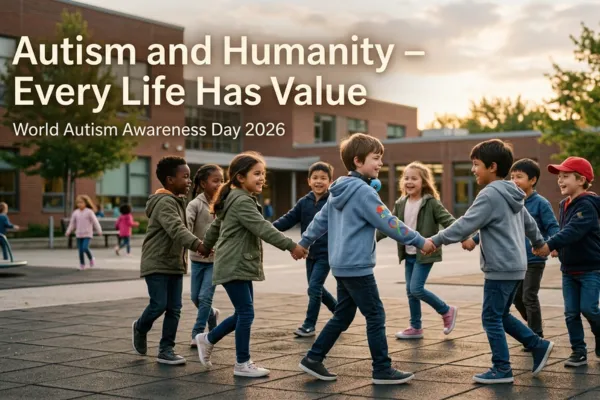
Autism and Humanity – Every Life Has Value
Introduction
Every year, World Autism Awareness Day invites the world to pause and take stock. In 2026, the theme Autism and Humanity – Every Life Has Value is not just a slogan. It is a moral audit. It asks a hard question: do our systems, our policies, and our everyday behaviors truly reflect that belief?
Autism is not rare, and it is not invisible. It exists in our schools, our clinics, and our communities. Yet the response to it remains fragmented. If every life truly has value, then that value must be visible in access to care, quality education, and social inclusion. Anything less is a gap between intention and reality.
The Significance of World Autism Awareness Day
World Autism Awareness Day is more than a date on the calendar. It is a strategic moment in global health advocacy. Established by the United Nations in 2007, the day was designed to elevate autism as a public health and human rights priority.
Its significance lies in three key areas.
First, it drives policy visibility. Governments and institutions are more likely to prioritize issues that are consistently brought into public discourse. Awareness days create that pressure point.
Second, it mobilizes communities. When awareness translates into conversations, it begins to shift perceptions and reduce stigma.
Third, it aligns stakeholders. Healthcare providers, educators, caregivers, and advocacy groups use this moment to push for coordinated action.
In simple terms, it is not just about awareness. It is about momentum.
The Global Burden of Autism: What the Numbers Say
Autism is far more common than many systems are prepared for. According to the World Health Organization, approximately 1 in 100 children globally are estimated to have autism.
In the United States, data from the Centers for Disease Control and Prevention shows prevalence rates as high as 1 in 36 children, reflecting improved detection but also a growing demand for services.
However, these numbers likely underestimate the true burden in low and middle income countries where diagnostic services are limited. Many children remain undiagnosed, misdiagnosed, or completely excluded from formal systems.
From a public health standpoint, this is not a marginal issue. This is a population level concern that demands structured, scalable responses.
Problems and Gaps in Autism Care
If the numbers tell one story, the lived reality tells another.
Limited Access to Early Diagnosis
Early diagnosis is critical for intervention, yet in many settings, children are diagnosed late. This delay reduces the effectiveness of therapies and limits developmental outcomes.
High Cost of Therapy
Speech therapy, occupational therapy, and behavioral interventions are often long term and expensive. Many families pay out of pocket, making sustained care financially exhausting.
Shortage of Skilled Professionals
There is a global shortage of trained therapists, developmental pediatricians, and special educators. This leads to long waiting times and inconsistent quality of care.
Fragmented Services
Healthcare, education, and social support systems often operate in silos. Families are left to coordinate care themselves, navigating a complex and disjointed system.
Stigma and Social Exclusion
Cultural beliefs and misinformation continue to shape how autism is perceived. Children are often excluded from schools and social activities, while families face judgment and isolation.
These gaps are not accidental. They are the result of systems that have not fully integrated autism into mainstream health and social planning.
Inclusive Healthcare Practices
If every life has value, then healthcare must reflect that value in practice. Inclusive healthcare is not an abstract concept. It is operational. It is measurable. And it is achievable.
Patient Centered Care
Healthcare must adapt to the needs of autistic individuals. This includes flexible communication methods, sensory friendly environments, and individualized care plans.
Early Screening Integration
Routine developmental screening should be part of primary healthcare. This allows early identification and timely referral for intervention.
Multidisciplinary Approach
Autism care requires collaboration between pediatricians, psychologists, therapists, and educators. Integrated care models improve outcomes and reduce fragmentation.
Caregiver Support Systems
Caregivers need training, counseling, and respite support. Supporting the caregiver directly improves the quality of care the child receives.
Training Healthcare Providers
Many healthcare professionals are not adequately trained in autism care. Continuous education is essential to improve diagnosis, communication, and management.
Inclusive care is not about doing more. It is about doing better, with intention and structure.
Solutions: Moving from Awareness to Action
Awareness without execution is wasted potential. The real work lies in building systems that deliver.
Policy and Funding
Governments must allocate dedicated funding for autism services, including early intervention programs and workforce development.
Community Based Programs
Decentralized care models bring services closer to families. Community centers, schools, and local organizations can serve as hubs for support.
Digital Health Integration
Telehealth and mobile health platforms can expand access, especially in underserved areas. They offer scalable solutions for therapy, monitoring, and caregiver education.
Public Education Campaigns
Sustained awareness efforts are needed to challenge stigma and promote inclusion. These campaigns must be culturally relevant and community driven.
Inclusive Education Systems
Schools must be equipped with trained staff, adaptive curricula, and support services to ensure meaningful participation for autistic children.
Research and Data Systems
Better data leads to better planning. Investment in research helps understand prevalence, outcomes, and effective interventions across different settings.
Conclusion
The theme Autism and Humanity – Every Life Has Value is not aspirational rhetoric. It is a standard of accountability.
Autism does not test the limits of individuals. It tests the limits of systems. It reveals where healthcare fails, where education excludes, and where society hesitates to include.
If every life has value, then that value must be visible in action. In policies that prioritize inclusion. In healthcare systems that adapt. In communities that choose empathy over judgment.
The real measure of 2026 will not be how loudly the theme is echoed, but how deeply it is implemented.
